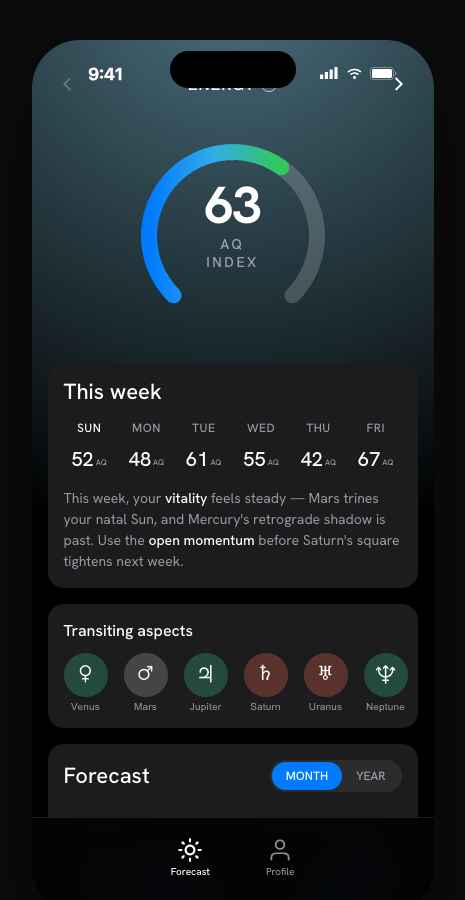
The sky is moving constantly — and so is your chart. AstroQuant turns today's transits into a single number, broken down across the eight things you actually live by. Read your sky like a chart.
Behind that single digit sit dozens of live calculations: planetary positions, transit angles, orb strength, retrograde shadows — all weighted against your natal chart, every minute.
Date, time, and place of birth define a fixed reference frame — the chart that's been turning above you since you were born.
Every planet's current position, computed by our own ephemeris engine — built from NASA JPL's source data, not a horoscope generator. The numbers are real astronomy.
Each transit's effect is scaled by how exact it is — a square within 2° hits harder than one drifting at 7°. The math is honest about that.
0 means friction. 100 means flow. Most days sit in the 40–70 corridor where life actually happens.
Most astrology apps lean on a third party for today's planetary positions and trust whatever comes back. We took NASA JPL's published ephemerides — the same data that flies spacecraft — and rebuilt them into our own engine, running on our own servers, fit for exactly one job: scoring transits against your chart the moment you open the app.
No black box. The ephemeris and the scoring both run on infrastructure we built and control — so when the sky moves, our math moves with it, to sub-arcsecond precision.
Each morning you wake up to a clean readout — your number for today, this week's trend, the transits worth paying attention to, and an honest summary of the weather.
The writeup uses italicised anchor words the way a thoughtful friend might — three or four per paragraph, never more. It tells you what's happening; it doesn't tell you what to do.
This week, your vitality feels steady — Mars trines your natal Sun and Mercury's retrograde shadow is past. Use the open momentum mid-week before Saturn's square tightens, then ease into a slower Thursday and let the weekend do its work.
A bad day for negotiating money isn't the same as a bad day for sleeping well — and the sky knows the difference. AstroQuant gives each of the eight areas its own daily reading.
Vitality, drive, and the basic willingness to start things. Mars rules this number more than any other.
Resilience and recovery. Low days suggest pacing; high days don't license neglect — they reward consistency.
Negotiations, asks, signings. Venus and Jupiter carry the most weight; Saturn is a strong cautionary voice.
Connection and chemistry — both new and existing. Venus retrograde shadows show up here first.
Focus, status moves, and how visible you are. Mercury and Saturn dominate the long-term shape.
Domestic stability and the IC of your chart. Moon transits move this number more than anything else.
Group dynamics and the wider social weather. The 11th-house transits show up loudest here.
Lower scores don't prohibit travel — they suggest friction, delays, the kind of day to leave an extra hour for.
AstroQuant isn't on the App Store yet. The beta is invite-only via TestFlight — and beta testers get a free lifetime account when the app goes public.
Apple's first-party beta-distribution app. Free, three taps, no Apple ID re-entry.
iPhone only ·Android, sit tight
Drop your iCloud email in the #request-beta channel. We add you to the distribution list within a day.
astroquant.discord.com
TestFlight pings you the moment you're added. One tap to install, then the app behaves like any other.
~12 MB · iOS 17+In Discord, in TestFlight, on a postcard — we read everything. The next build usually ships within the week.
Beta testers → lifetime freeBeta access is free, the install takes a minute, and the app's been running on the founders' phones for a year.